01 Lie angle, the cheapest fix in golf
Lie angle is the angle between the shaft and the ground when the club is soled properly. If it is too upright for you, the heel of the club digs in first at impact and the face is effectively pointing left of where you aimed. Too flat, and the toe digs first and the face points right. The golfer strikes the ball perfectly and watches it start offline anyway.
The size of the error grows with loft. A four iron mis-fitted by two degrees will drift slightly. The same two degrees on a pitching wedge will send an otherwise perfect shot several yards off the flag, which is why lie angle deserves attention exactly where accuracy matters most.
Checking it is straightforward. A fitter puts impact tape on the sole of the club and asks you to hit a shot off a hard lie board. The scuff mark shows which part of the sole touched first: towards the heel means too upright, towards the toe means too flat, in the middle means correct. Adjusting forged irons is a bench operation that takes minutes.
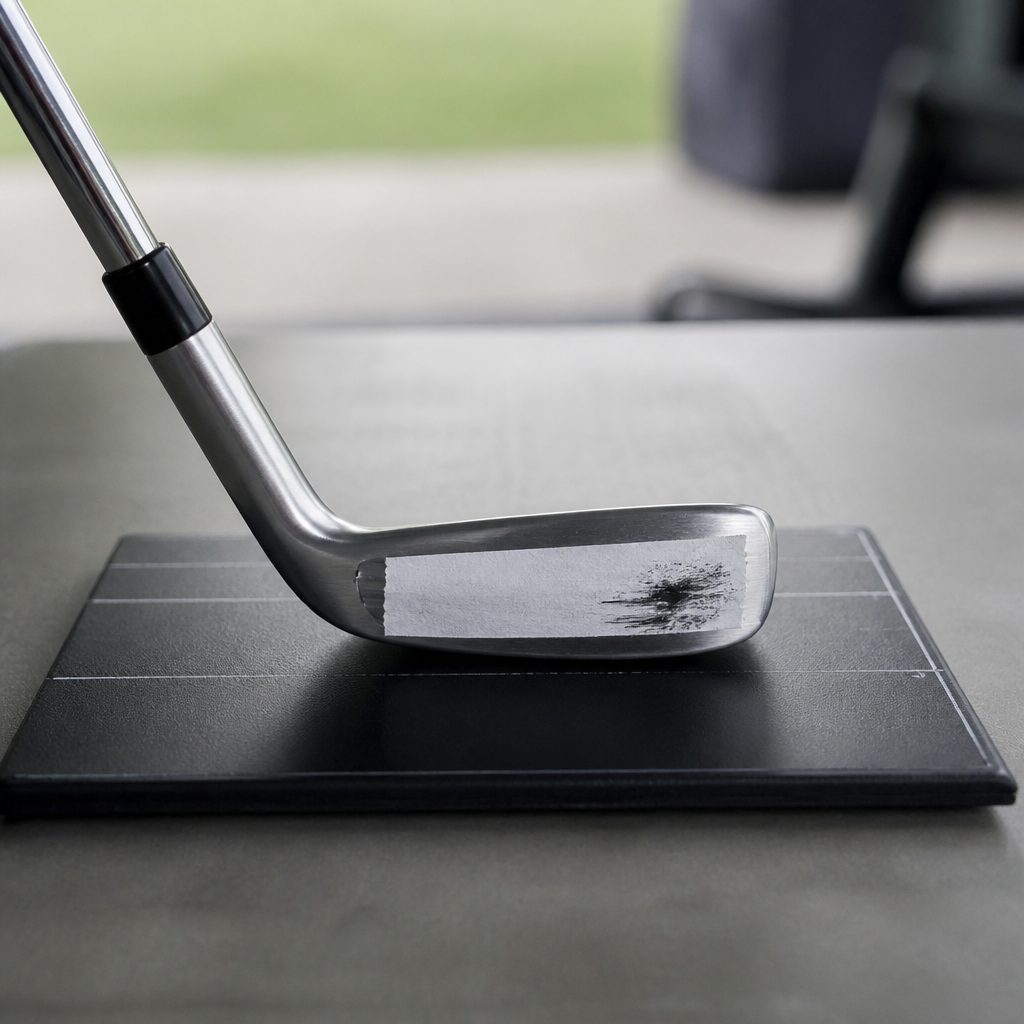
02 Length and the strike pattern

Length changes two things at once: how far you stand from the ball, and how much control you have over where on the face you strike it. A club that is too long for a player usually produces strikes towards the heel and a posture that stands up through impact. A club that is too short pulls the strike towards the toe and encourages an early low point.
Static measurements, height and the distance from wrist to floor, give a starting length. They are a starting point only: two players of identical height with different postures need different clubs, and the honest test is where the ball marks the face after twenty shots.
Length and lie interact, which is why they are always fitted together. Lengthening a club without
Grip sizing also depends on what the hand actually holds, since gloves use Cabretta leather or textured microfiber and grips use rubber that can feel tacky or polished smooth. A fitter checks how glove palm and grip rubber keeps friction when hands are dry or damp and whether the glove is fresh or worn. Bare skin on rubber turns slippery with moisture, so the palm material is chosen to give steady friction across conditions.
adjusting the lie effectively makes it flatter in use, and shortening it makes it more upright. A fitter who changes one without mentioning the other is not finished.03 Shaft: weight first, flex second
Shafts are sold on flex and fitted on weight. Weight is what most golfers feel: a heavier shaft tends to slow the transition and tighten dispersion, a lighter one adds speed and, for some players, adds scatter with it. The right weight is usually the heaviest one that does not cost you speed.
Flex matters, but the labels do not travel. There is no industry standard behind R, S and X, so a stiff shaft from one manufacturer can measure softer than a regular from another. That is why flex has to be fitted by hitting shots and looking at launch and dispersion, never by reading a chart of swing speeds.
Tempo matters as much as speed. Two players swinging at the same club head speed, one with a smooth transition and one with an aggressive one, load a shaft very differently and will end up in different flexes. If a fitter asks about your transition, that is a good sign.
Caddie note
Be wary of a fitting session that finishes with the longest drive of your life. Any strong player can produce one outlier. What matters is the tightest group of fifteen shots, and a good fitter will show you the whole dispersion rather than the best number in it.
04 Grip size and hand action

Grip size governs how freely the hands can rotate the club. A grip that is too small for the hand allows more rotation, which tends to close the face; one that is too large restricts it and tends to leave the face open. It is a genuine directional variable, and it is the cheapest one on the list to change.
Sizing starts from hand measurements, glove size and the distance from the wrist crease to the tip of the middle finger, and finishes with how it feels holding the club without squeezing. Grip pressure that has to be high to keep the club stable is usually a sizing problem, not a determination problem.
Grips also wear out. A shiny, hardened grip makes players hold on tighter, which restricts the release and quietly changes ball flight over a season. Replacing them is one of the few maintenance jobs in golf with an immediate effect on the shot.
05 The driver: loft, spin and attack angle
Driver distance comes from ball speed, launch angle and spin rate working together. For a given ball speed, carry is generally maximised by launching the ball relatively high with relatively low spin. That combination is not achieved by choosing a lower lofted head, which is the mistake most amateurs make, but by changing how the club arrives.
The key variable is attack angle: whether the head is moving down or up at impact. Hitting slightly up on a driver from a tee raises launch and reduces spin at the same time, which is exactly the combination that adds carry. Hitting down on it does the opposite, and no amount of loft tinkering fully compensates.
Spin also depends on where the ball meets the face. A strike high on the face spins less, a strike low spins more, which is the vertical version of the gear effect explained in the ball flight chapter. Fitting a driver without looking at strike location is fitting the wrong thing.
06 Symptom table
Use this to arrive at a fitting with a question rather than a budget. Each row assumes the strike is reasonably centred: if it is not, tighten the strike first.
| Symptom | Likely variable | How it is checked |
|---|---|---|
| Well struck irons finish left of target | Lie too upright | Impact tape on a lie board |
| Well struck irons finish right of target | Lie too flat | Impact tape on a lie board |
| Strikes gathering towards the heel | Length, or standing too close | Face spray over twenty shots |
| Drives climbing and falling short | Spin too high | Launch monitor, plus strike height on the face |
| Drives flat and diving | Launch too low for the spin | Launch monitor, loft and attack angle |
| Wedges hooking, long irons fine | Grip size, or upright short irons | Hand measurement, then lie board |
| Dispersion widening late in a round | Shaft weight or grip wear | Compare first and last nine on a launch monitor |
07 What a good session includes
- A baseline with your own clubs, so every change is measured against something real.
- Enough shots per configuration to see a pattern, not three swings and a verdict.
- Strike location data, from face spray or tape, alongside the launch numbers.
- Dispersion shown as a whole group, with the outliers included rather than deleted.
- A written specification at the end: length, lie, loft, shaft model and weight, grip and size, so the fit can be repeated or checked later.
Two practical points. Book the session when you are fresh, because a fit built on a tired swing is a fit for a swing you rarely have. And if you are indoors on a radar system, use the ball you actually play, since the ball affects spin readings and therefore every conclusion drawn from them, as explained in the golf ball chapter.
Fitting changes the club, not the swing, and the same limit applies to any plan built on paper. A lie adjustment, a heavier shaft, or a larger grip can reduce a miss, yet none of it accounts for conditions that shift after the first stroke. Paddlers face that same gap between preparation and reality, which is why Cold water and crossing plans asks how wind, current and cold water shape a paddling plan before launch.
Fitting settles the club, not the swing, and the same discipline applies when you plan a dive trip: match the gear and the plan to the conditions you will actually meet. Depth, certification and shore entries decide more than ambition does, and a site that looks simple from the boat can ask for a different level once you are in the water. The same question comes up for La Catedral and San Andres: is the Isla de San Andres worth diving?
Fitting answers the club, not the course. Once lie, length, shaft weight and flex, grip size, and driver loft are set, the remaining variables are the player's. A different kind of layout, one where a lap is measured in named corners rather than yards, raises a separate question about how a place gets its shape. That question is the one behind Why Bray Hill is remembered, where the length, start, and corners of the Snaefell Mountain Course are set out.