01 Three questions before you touch the ball
Every relief decision comes down to the same three questions, asked in the same order. Answer them before you pick anything up, because once a ball has been lifted without a rule behind it, the options narrow.
- Where is the ball? General area, bunker, penalty area, putting green, or out of bounds. The area you are in changes which reliefs exist.
- Is the problem the course or the shot? Course conditions such as temporary water, a cart path or an animal hole give free relief. A bad lie you simply do not like does not.
- What does each option cost? Free, one penalty stroke, or two. Then choose the cheapest option that actually leaves you a shot, not the one that feels least embarrassing.
Note that free relief is never available for a ball in a penalty area. Inside a red or yellow
If a ball is lost or out of bounds, golfers must play again from the spot of the previous stroke and add one penalty stroke. The guide to stroke and distance with one penalty describes that procedure under Rule 18 and when golfers hit a provisional ball before going forward to search.
marked area, the interference of a cart path or casual water changes nothing: your options are the penalty area options, or playing it as it lies.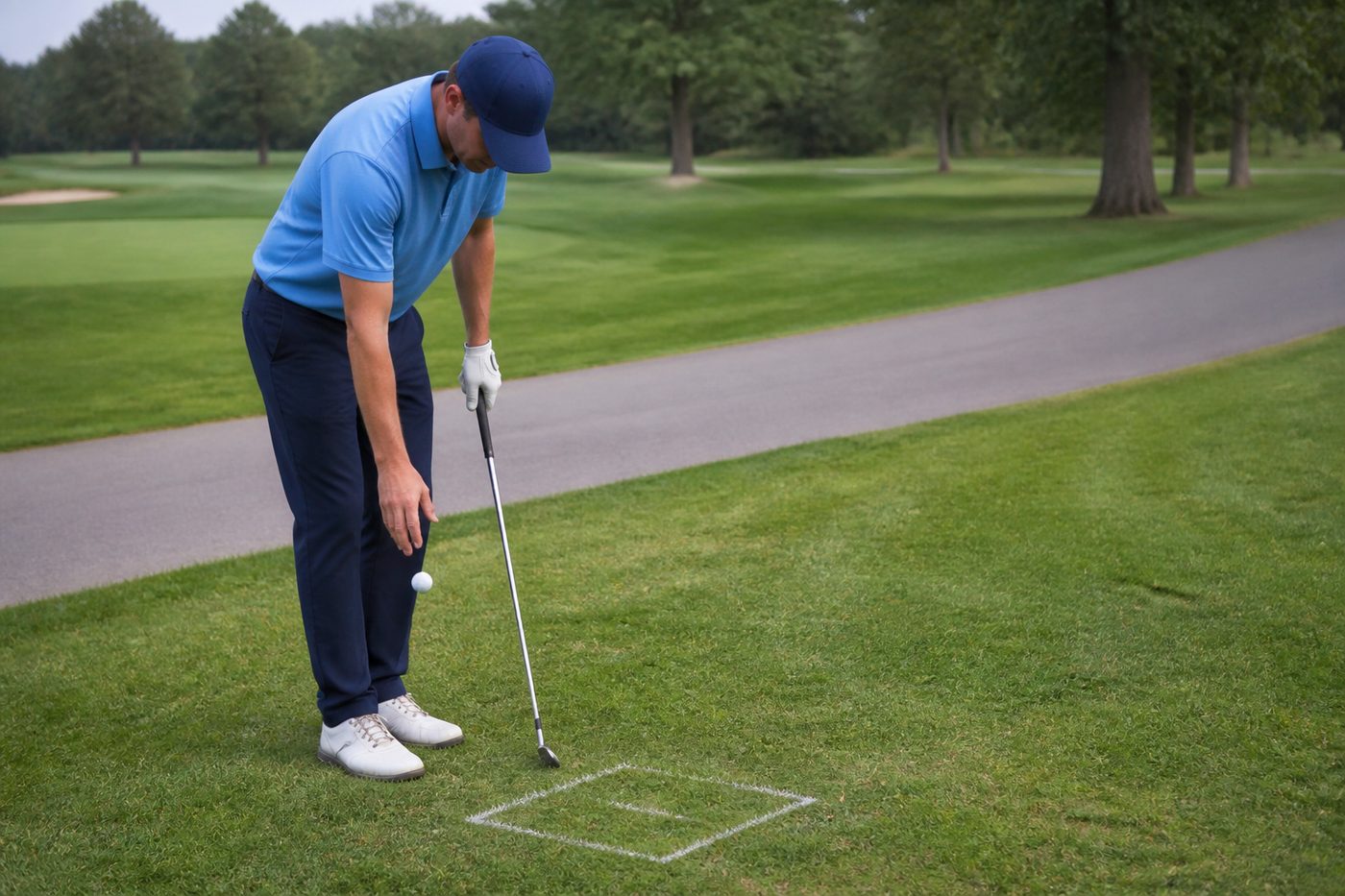
02 Free relief from course conditions

The rules group four things together as abnormal course conditions: temporary water, ground under repair, animal holes, and immovable obstructions such as cart paths, sprinkler heads and staked young trees. If one of them interferes with your lie, your stance or your intended swing, relief is free.
The procedure has two steps that people routinely get wrong. First you find the nearest point of complete relief: the nearest spot, not nearer the hole, where the condition no longer interferes at all, and in the same area of the course. It is a point you identify, not a point you choose, and it can easily be on the wrong side of the path for a right-handed player. Then you drop within one club-length of that point, no nearer the hole.
Two special cases. In a bunker, this relief is free only if you drop inside the bunker; taking the ball out of the bunker costs one penalty stroke and is done on the line back from the hole. On the putting green, the ball is placed at the nearest point of complete relief rather than dropped.
Caddie note
Temporary water is not the same as soft ground. The test is whether water is visible before or after you take your stance without pressing down hard. Squelching turf that shows nothing on the surface is just a wet course.
03 Penalty areas, red and yellow
A penalty area is any area marked by the committee where a ball is often lost or unplayable: water, but also gorse, deep ditches and desert scrub. Two things surprise golfers who learned the old hazard rules. You may play the ball as it lies from inside a penalty area with no penalty at all, and since the 2019 revision you may ground your club and move loose impediments while doing so.
If you would rather not, relief costs one penalty stroke, and the colour of the stakes decides how many options you have. In every case the reference is the point where the ball last crossed the edge of the penalty area, which is an estimate you and your playing partners agree on.
Yellow: two options
- Stroke and distance. Replay from where you played the last shot.
- Back on the line. Keep the point where the ball last crossed the edge between you and the hole, go back as far as you like along that line, and drop there. Going further back is allowed and often gives you a better yardage than the shortest option.
Red: three options
- Both of the yellow options above.
- Lateral relief. Drop within two club-lengths of the point where the ball last crossed the edge, no nearer the hole. This is the option most golfers actually want, and the reason red stakes are far friendlier than yellow ones.
One habit saves arguments: before anyone walks on, agree out loud where the ball crossed the edge. That point, not where the ball is now visible in the water, is what every option is measured from.
04 The unplayable ball

You alone decide that a ball is unplayable, and you may do so anywhere on the course except inside a penalty area. It costs one penalty stroke and gives three options, all measured from where the ball lies:
- Stroke and distance: go back and replay from the previous spot.
- Back on the line: keep the ball's spot between you and the hole and go back as far as you wish along that line.
- Lateral: drop within two club-lengths of the spot, no nearer the hole.
In a bunker the same three options exist, but the ball must be dropped inside the bunker. There is a fourth choice worth remembering when the lie is genuinely hopeless: for two penalty strokes you may take back-on-the-line relief outside the bunker. On a plugged lie under a steep lip, two strokes and a clean swing frequently beats one stroke and three more attempts at the same wall of sand.
The arithmetic is worth doing on the spot. A buried lie that realistically takes two attempts to escape costs you the same as taking the two-stroke option, and the two-stroke option leaves you with a full shot into the green instead of a sand-filled collar.
05 Lost ball and out of bounds
Search time is three minutes, reduced from five in the 2019 revision, and it starts when you or your caddie begin looking. If the ball has not been found by then it is lost, and the basic remedy is stroke and distance: one penalty stroke, and play again from where you played the previous shot. The same applies to a ball out of bounds.
Which is why the provisional ball exists. If there is any doubt at all, announce clearly that you are playing a provisional, and play it before you walk forward to search. Both parts matter: a second ball played without the word "provisional" becomes your ball in play, and once you have gone forward to look, the chance to play a provisional has gone.
Many clubs also adopt a model local rule intended for everyday play, which offers an alternative to walking back. For two penalty strokes it lets you drop in a defined area based on where the ball went out of bounds or was lost and the nearest edge of the fairway, no nearer the hole. It is not available if you have already played a provisional, and it is not intended for elite competition. Whether it applies at your course is written on the scorecard or the notice board, not in the rule book.
Caddie note
In a friendly round, the pace of play argument beats the purist argument. Play a provisional whenever the ball flies towards trouble. The worst case is that you pick it up again, having lost nothing at all.
06 Dropping so the drop counts
Since 2019 a ball is dropped from knee height, meaning the height of the knee of a standing player, not from shoulder height as in the old rules. It must be dropped by the player, released straight down without spin or throw, and it must both land in the relief area and come to rest in it.
- Establish and mark the reference point, then measure the relief area with the longest club in your bag other than the putter.
- Drop from knee height, letting go of the ball rather than tossing it.
- If the ball rolls out of the relief area, drop a second time in the same way.
- If it rolls out again, place the ball on the spot where it first touched the ground on that second drop.
Two definitions do a lot of work here. A club-length is the longest club you carry apart from the putter, so a driver, and it is worth knowing exactly how far that reaches. And the relief area is a defined space, not a general neighbourhood: playing from outside it is playing from a wrong place, which carries the general penalty of two strokes in stroke play.
07 Quick reference table
Six lines to photograph and keep on your phone. Where a local rule applies, it replaces the row below it.
| Situation | Main options | Penalty |
|---|---|---|
| Cart path, sprinkler, casual water, animal hole | Nearest point of complete relief, then one club-length | None |
| Ball in a yellow penalty area | Play as it lies, stroke and distance, or back on the line | None, or one stroke for relief |
| Ball in a red penalty area | All of the above plus two club-lengths from the crossing point | None, or one stroke for relief |
| Unplayable lie in the general area | Stroke and distance, back on the line, or two club-lengths | One stroke |
| Unplayable lie in a bunker | The three options inside the bunker, or back on the line outside it | One stroke inside, two strokes outside |
| Lost ball or out of bounds | Stroke and distance, or the local alternative if the club has adopted it | One stroke, or two under the local rule |
Once a hole has gone wrong, the other thing worth knowing is how much damage it can actually do to your record. Under the handicap system there is a ceiling on the score that counts for any single hole, which is explained in the chapter on how handicaps are calculated.
08 Terms used on this page
- General area
- Everything on the course except the teeing area of the hole being played, all penalty areas, all bunkers and the putting green.
- Penalty area
- An area marked red or yellow by the committee where a ball is often lost or unplayable. Water, but also scrub, ditches and marked rough.
- Abnormal course condition
- Temporary water, ground under repair, an animal hole, or an immovable obstruction. Interference from any of them gives free relief.
- Nearest point of complete relief
- The nearest spot, not nearer the hole, where the condition no longer interferes with lie, stance or swing. It is identified, not chosen.
- Relief area
- The measured space in which a dropped ball must land and come to rest, one or two club-lengths from a reference point depending on the rule.
- Club-length
- The length of the longest club in your bag other than the putter, used to measure every relief area.
- Provisional ball
- A second ball played, and announced as provisional, before going forward to search, in case the original is lost outside a penalty area or out of bounds.
Relief decisions on the course often come down to space and timing: where a ball may be dropped, how far a player stands from a hazard, and whether a provisional ball saves a walk back. A touring street company faces a comparable question of room and risk, since a playing area of ten by eleven metres must hold both the performance and the people watching it. Capacity and evacuation planning covers how a crowd of three hundred to a thousand is managed, along with first aid and exit routes.
Relief decisions on the course often come down to who set the rules and why they exist. A committee marks penalty areas, defines ground under repair, and decides when a ball is unplayable, and those choices shape every drop a player makes. The same question applies away from golf: recreational sports run on written rules and volunteer organizers, and beginners rarely know who makes the calls. For a plain-English look at how one of those community sports is organized, see Who runs a community league.