01 Ball flight and the full swing
Worked through in the ball flight chapter, which explains how these combine into the nine possible flights.
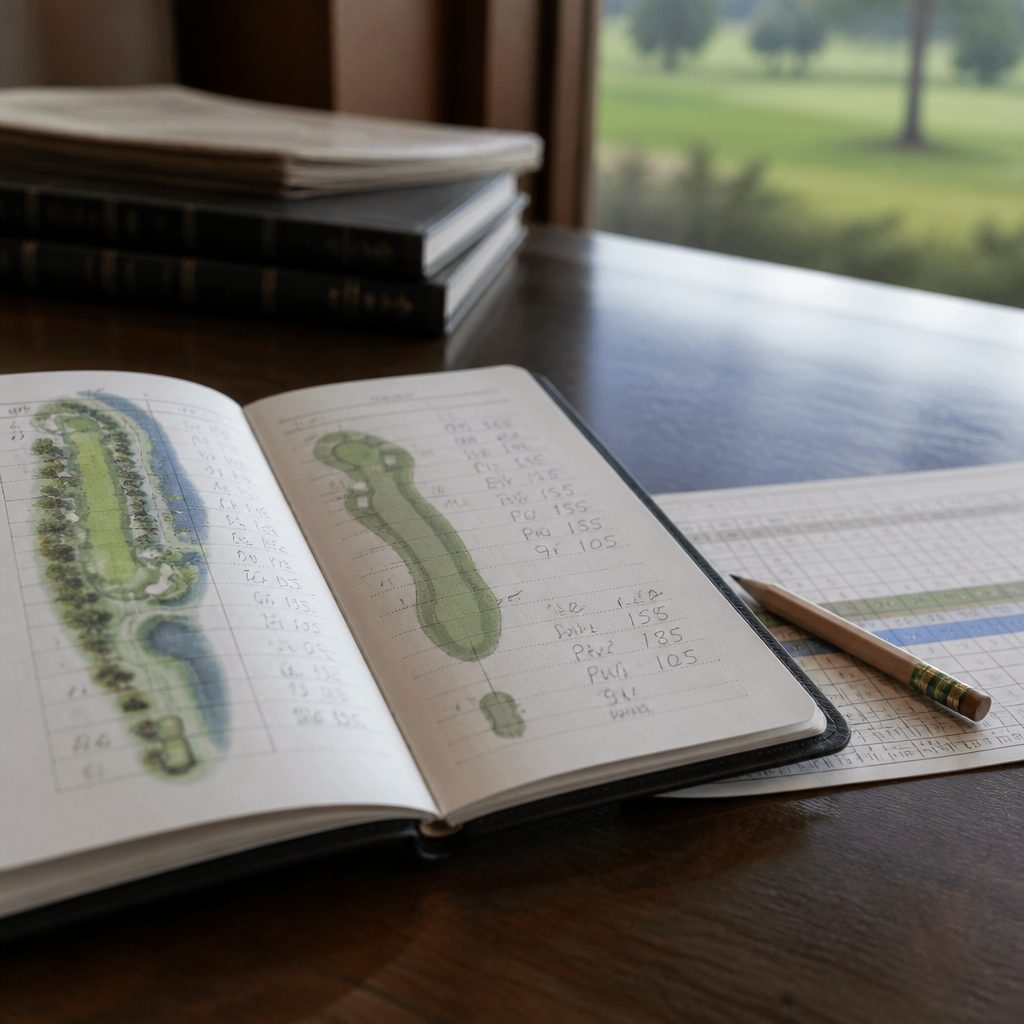
- Face angle
- Where the club face points at impact, measured against the target line. It dominates the start direction of the shot.
- Club path
- The horizontal direction the club head travels at impact, measured against the target line. In-to-out points right, out-to-in points left.
- Face to path
- The face angle measured against the path rather than the target. This difference, not the face alone, produces curvature.
- Spin axis
- The tilt of the ball's axis of rotation. A tilt right sends the ball right; a level axis flies straight.
- Attack angle
- Whether the head is moving down or up at impact. Negative with irons, often positive with a driver from a tee.
- Low point
- The deepest point of the swing arc. With an iron it should sit ahead of the ball, which is why the divot starts in front of it.
- Gear effect
- Spin added by an off-centre strike as the head twists around its centre of gravity. Toe strikes add draw spin, heel strikes add fade spin.
- Smash factor
- Ball speed divided by club head speed. Close to 1.50 for a well struck driver, lower for lofted clubs.
- Bulge and roll
- The horizontal and vertical curvature of a driver face, built in to compensate for gear effect.
- Push, pull, fade, draw
- A push starts right and a pull starts left, describing start direction. A fade curves right and a draw curves left, describing shape. The two are independent.
02 Around the green

Worked through in the short game chapter, where the carry and roll ratios by club are set out.
- Leading edge
- The front edge of the club face where it meets the sole. The part that digs when the bounce is not being used.
- Bounce angle
- The angle between the leading edge and the lowest point of the sole, measured with the club soled flat.
- Effective bounce
- The bounce actually presented at impact. Leaning the shaft forward reduces it, opening the face increases it.
- Grind
- Material shaped away from the sole of a wedge to change how it sits and interacts with turf, especially with the face open.
- Landing spot
- The specific point on the green a chip or pitch is aimed to land on, chosen before the club is selected.
- Carry to roll
- The ratio of flight distance to ground distance for a given club. More loft means more carry and less roll.
- Fringe and apron
- The band of shorter grass immediately around a putting green, cut longer than the green itself.
- Short-sided
- Missing a green on the side where the flag is, leaving very little green to work with.
03 On the green
Worked through in the putting chapter, with make rates by distance.
- Stimpmeter
- A grooved ramp used to measure green speed. The reading is the distance in feet a released ball rolls on a flat part of the green.
- Green speed
- How fast the surface is, expressed as the Stimpmeter reading. Most club greens sit between eight and ten feet.
- Break
- The sideways curve of a putt caused by slope. It increases as the ball slows, so most of it happens near the hole.
- Capture speed
- The range of speeds at which a ball arriving at the hole will actually fall in rather than lip out.
- Grain
- The direction grass blades lie, noticeable on bermuda greens, which speeds up or slows down putts running with or against it.
- Lag putt
- A long putt played to finish close rather than to be holed, where the target is a circle around the hole.
04 Rules and relief
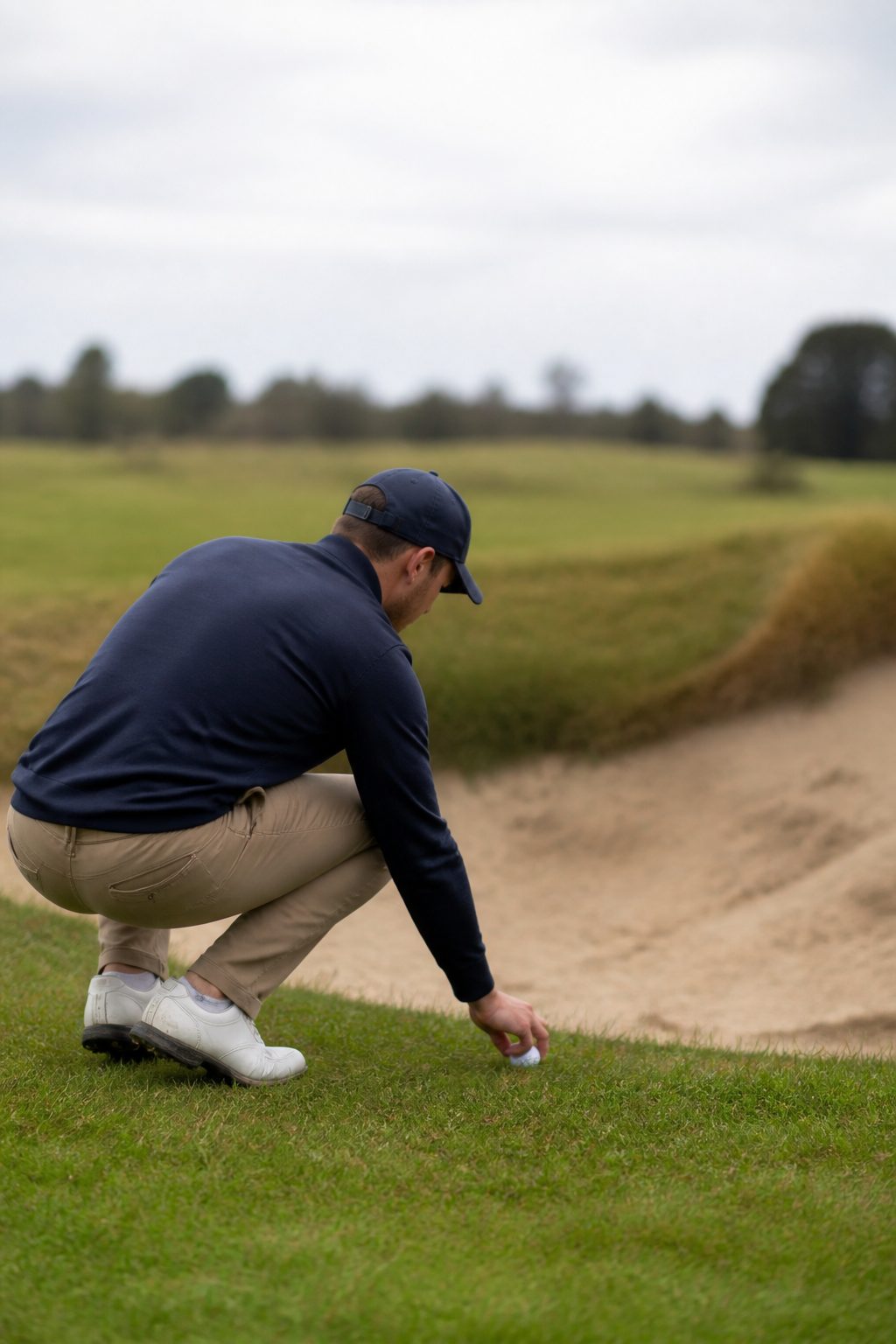
Worked through in the relief and penalties chapter. The official definitions are those published by the USGA and The R&A.
- General area
- Everything on the course except the teeing area of the hole being played, all penalty areas, all bunkers and the putting green.
- Penalty area
- An area marked red or yellow where a ball is often lost or unplayable. Water, but also ditches, scrub and marked rough.
- Abnormal course condition
- Temporary water, ground under repair, an animal hole or an immovable obstruction. Interference gives free relief.
- Nearest point of complete relief
- The nearest spot, not nearer the hole, where the condition no longer interferes with lie, stance or swing. It is identified, not chosen.
- Relief area
- The measured space in which a dropped ball must land and come to rest, one or two club-lengths from a reference point depending on the rule.
- Club-length
- The length of the longest club in the bag other than the putter, used to measure every relief area.
- Stroke and distance
- One penalty stroke plus replaying from where the previous stroke was made. The basic remedy for a lost ball or a ball out of bounds.
- Provisional ball
- A second ball, announced as provisional and played before going forward to search, in case the original is lost outside a penalty area or out of bounds.
- Loose impediment
- A natural loose object such as a stone, leaf or twig. It may be moved anywhere on the course, including in a bunker.
- Local rule
- A rule adopted by the committee for a particular course or competition. Where one applies, it governs.
05 Handicaps and scoring
Worked through in the handicap chapter, with the formulas and a worked example.
- Handicap Index
- A portable measure of demonstrated ability, the average of the best eight score differentials from the most recent twenty rounds.
- Course Rating
- The score a scratch golfer is expected to shoot from a given set of tees, expressed to one decimal place.
- Bogey Rating
- The equivalent expectation for a bogey golfer, roughly a 20 handicap man or 24 handicap woman.
- Slope Rating
- How much faster a course gets harder from scratch towards bogey level. It runs from 55 to 155, with 113 as the standard.
- Score Differential
- One round expressed in handicap units, calculated as 113 divided by the slope, multiplied by the adjusted gross score minus the course rating and any conditions adjustment.
- Course Handicap
- The index converted to the tees being played, including an adjustment for the difference between course rating and par.
- Playing Handicap
- The course handicap after the competition's handicap allowance has been applied.
- Net double bogey
- The maximum score that counts for handicap purposes on any hole: par, plus two, plus any strokes received on that hole.
- Playing Conditions Calculation
- An automatic daily adjustment applied when scores show that conditions were unusually hard or easy.
- Stableford
- A points format scored against a fixed score for each hole, so that one disastrous hole costs only that hole.
06 Equipment
Worked through in the fitting chapter and the golf ball chapter.
- Lie angle
- The angle between the shaft and the ground with the club soled. Too upright points the face left, too flat points it right, for a right-hander.
- Loft
- The angle of the face relative to the shaft, which governs how high and how far a club sends the ball.
- Dynamic loft
- The loft actually delivered at impact, which differs from the loft stamped on the club depending on shaft lean and attack angle.
- Shaft flex
- How much a shaft bends under load. The labels are not standardised between manufacturers, so flex has to be fitted by hitting shots.
- Impact tape
- Adhesive tape applied to the sole or face to record where contact happened, used to diagnose lie angle and strike location.
- Urethane cover
- A soft ball cover that grips the grooves and produces high greenside spin, at the cost of durability.
- Ionomer cover
- A firmer, more durable ball cover, often known by the trade name Surlyn, with lower greenside spin.
- Compression
- How much a ball deforms under a standard load. It governs feel far more than distance for most golfers.
- Overall distance standard
- The maximum distance a conforming ball may travel under specified test conditions, set by the governing bodies.
- Conforming list
- The published lists of clubs and balls that meet the equipment rules and may be used in competition.
Time limits matter in every sport, and golf is no exception: a player gets a set period to search for a lost ball before the clock runs out. Handball applies a similar idea to possession, capping how long the ball may be held before a pass, a dribble or a shot. The same page covers the court, the steps and the Seven positions in handball, so a reader can see how each limit fits the rest of the game.
Definitions cover the language of play, but records of a life ask for the same care with evidence. A studio portrait, a bundle of letters, a village register: each supports only so much, and the method matters more than the conclusion. Migration, work and place names are read together, not one at a time, and interpretation stops where the documents stop. For a short method applied to those questions, see Tracing an ordinary life.