01 What a handicap index measures
A handicap index is a measure of demonstrated ability: what you can do when things go reasonably well, not what you do on average. That single design choice explains most of the things golfers find surprising about it. Bad rounds barely move it. Good rounds move it quickly. And two players with the same index will not usually shoot the same score on any given day, because the index describes potential rather than expectation.
The system is worldwide, so an index earned at one course means something at another. It is capped at 54.0, which deliberately makes the game measurable for beginners, and it can be established from as few as 54 holes of golf, in any combination of nine and eighteen hole rounds.
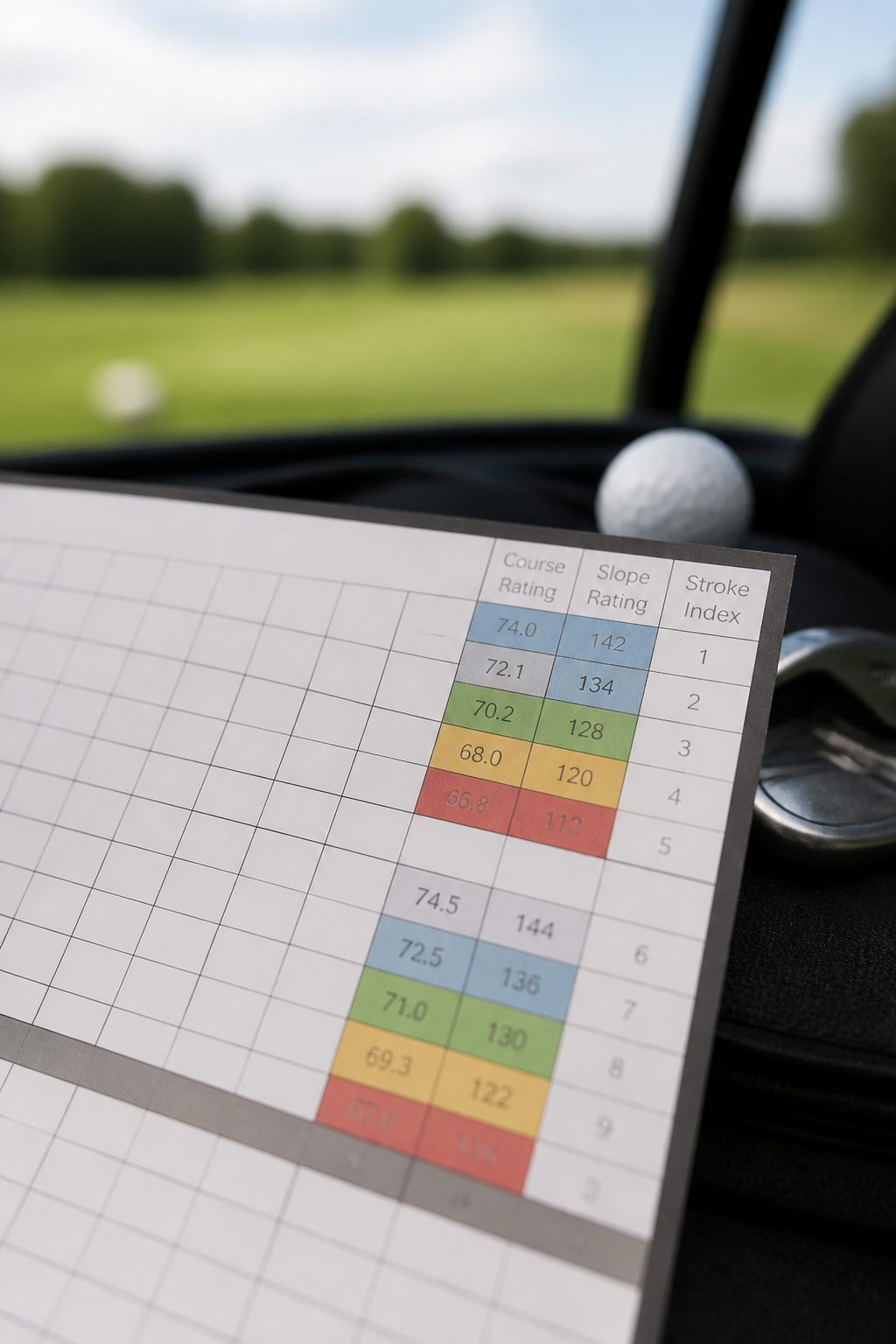
02 Course Rating, Bogey Rating and Slope

Par is not a measure of difficulty. It is a number chosen by the club, mostly from hole length. The two ratings are the real measures, and both are produced by trained raters who walk the course and assess length and obstacles from each set of tees.
- Course Rating is the score a scratch golfer is expected to shoot from that set of tees, written to one decimal place. A course rated 71.3 off the whites is a little harder than its par of 72 suggests for a scratch player.
- Bogey Rating is the same idea for a bogey golfer, roughly a 20 handicap man or a 24 handicap woman.
- Slope Rating expresses how much faster the course gets harder as you move from scratch towards bogey. It runs from 55 to 155, and the standard value, the one that represents a course of average relative difficulty, is 113. That number appears in every formula in this chapter.
The distinction matters at the first tee. A long, open course may have a high course rating and a modest slope: hard for everyone, but not disproportionately harder for a mid-handicapper. A shorter course covered in forced carries and thick rough may have a lower course rating and a much higher slope, because the scratch player copes and the bogey golfer does not.
03 Turning one card into a differential
Each acceptable round produces one score differential, which is that round expressed in handicap units so it can be compared with rounds played anywhere else. The formula is:
Score Differential = (113 ÷ Slope Rating) × (Adjusted Gross Score − Course Rating − PCC)
The adjusted gross score is your total after applying the maximum hole score described in section six. PCC stands for playing conditions calculation: an automatic daily adjustment, applied when scores across the course show that conditions were unusually hard or easy, ranging from minus one to plus three. Most days it is zero, and you will never need to calculate it yourself.
Notice what the formula does. Dividing 113 by the slope shrinks a score made on a course that is brutal for higher handicaps, and inflates one made on a gentle course. Subtracting the course rating rather than par means you are measured against what a scratch player would be expected to shoot that day, not against a number painted on a signboard.
04 Best eight of twenty, and the caps

Your index is the average of the best eight score differentials among your most recent twenty. The other twelve are ignored entirely. This is why a single disaster round changes nothing, and why the system is described as measuring demonstrated ability.
With fewer than twenty scores on record a sliding scale applies, using fewer differentials with an adjustment. With only three rounds posted, for example, the index is the lowest differential minus 2.0. As scores accumulate, the calculation moves steadily towards the standard best eight of twenty.
Two safeguards stop an index drifting upwards after a rough patch, both measured against your low handicap index, the lowest index you have held in the previous twelve months:
- Soft cap. Once the calculated index would rise more than 3.0 above that low index, the part of the increase beyond 3.0 is halved.
- Hard cap. The index cannot rise more than 5.0 above the low index at all.
Indexes are recalculated daily, so a score posted this evening applies to tomorrow's round. The practical duty on the player is simple and often ignored: post every acceptable score, including the bad ones. They will not damage your index, and their absence quietly turns your record into fiction.
Caddie note
A player who posts only good rounds ends up with an index that flatters them and a competition record that never improves. The system is built to absorb bad days: the twelve worst differentials of your last twenty are thrown away before the arithmetic even begins.
05 Course handicap and playing handicap
The index is portable, but it is not what you write on a card. It has to be converted for the specific set of tees you are playing:
Course Handicap = Handicap Index × (Slope Rating ÷ 113) + (Course Rating − Par)
The first part scales your index to the difficulty of these tees. The second part, added in the 2024 revision for all golfers, accounts for courses whose rating differs from their par, so that players competing from different tees are on genuinely equal terms. The result is rounded to a whole number.
Some formats then apply a handicap allowance to produce a playing handicap: a percentage set for the competition format, such as ninety-five per cent in individual stroke play or a lower figure in fourball formats. Allowances are decided by the committee running the event, so the number on the sheet is the one that counts.
06 Net double bogey
For handicap purposes, no hole can cost you more than net double bogey: the par of the hole, plus two, plus any handicap strokes you receive on that hole according to its stroke index. A nine on a par four where you receive one shot is recorded as a seven for handicap purposes, whatever you actually wrote on the card for the competition.
This is the ceiling that stops one lost ball from distorting an entire record, and it is also the reason the adjusted gross score in the differential formula is called adjusted. In casual play, picking up once you have reached your maximum for a hole is entirely legitimate: record the net double bogey and keep the group moving.
It is worth pairing this with the options in the relief and penalties chapter. Knowing both means you can do the arithmetic standing over a bad lie: what the cheapest legal escape costs, and what the hole can cost you at worst.
07 A worked example
The figures below are invented for the purpose of showing the arithmetic. Take a player with a handicap index of 14.2, playing a set of tees rated 71.3 with a slope of 128, on a course of par 72.
- Course handicap. 14.2 × (128 ÷ 113) = 16.1, then add the rating minus par, 71.3 − 72 = −0.7. That gives 15.4, rounded to 15 strokes for the round.
- Play the round. Suppose the player returns an adjusted gross score of 91 after applying net double bogey on two blow-up holes, on a day where the playing conditions calculation is zero.
- The differential. (113 ÷ 128) × (91 − 71.3) = 0.883 × 19.7 = 17.4.
- What happens to it. That 17.4 joins the record. It only affects the index if it is among the best eight of the most recent twenty differentials, which, for a player whose index is 14.2, it is not. The round changes nothing, and that is the system working as designed.
Run the same arithmetic on your own best card from last season. It is the quickest way to see why an index sits well below your typical score, and why chasing it with one good round is not how it moves.
08 Stableford, in one table
Stableford is the format most club competitions use, because a disaster hole costs you one bad hole rather than the whole card. Points are awarded against a fixed score, normally the par of the hole adjusted by the strokes you receive.
| Result on the hole | Points |
|---|---|
| More than one over the fixed score, or no score returned | 0 |
| One over the fixed score | 1 |
| Fixed score | 2 |
| One under | 3 |
| Two under | 4 |
| Three under | 5 |
| Four under | 6 |
Thirty-six points is the notional par of a stableford round for a player receiving their full handicap. It is also a useful practice target: play nine holes, count points, and you have a measurement that ignores the one hole where everything went wrong.
Handicap math rewards consistency, but other sports count differently. In team handball, a player may take only three steps without dribbling, and may hold the ball no longer than three seconds before passing, shooting or bouncing it. Those limits shape every attack, much as the best eight of twenty scores shape a handicap. The court dimensions, the seven positions and the youth adaptations are set out in the guide to The three-step and three-second rules.
A handicap index rests on numbers that can be checked: Course Rating, Slope, score differentials, the best eight of twenty, and the soft and hard caps that limit how fast it moves. The same restraint applies away from golf. A studio portrait, a bundle of letters or a village register can support only so much, and the reading of place names and everyday objects as historical evidence has limits. Where interpretation stops is the question that page takes up.