01 What is inside a golf ball
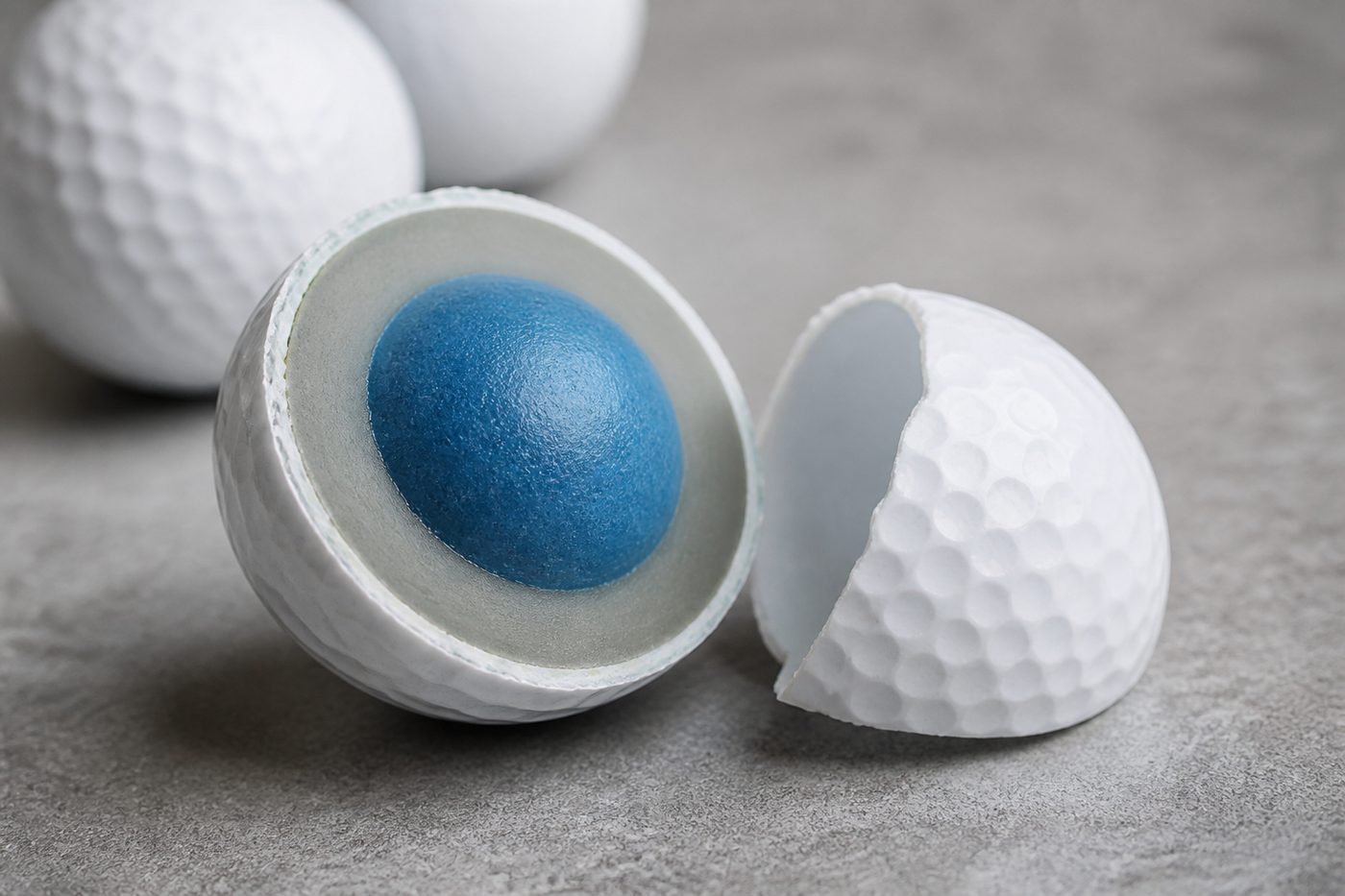
A modern golf ball is built in layers around a rubber core. A two-piece ball is exactly that: a large core and a cover. A three-piece ball adds a mantle between them, and four and five piece constructions subdivide further. Each layer is tuned to respond differently depending on how hard the ball is struck.
The design logic is worth understanding, because it explains the marketing. A driver compresses the ball deeply and mostly interacts with the core, so the core is tuned for speed and low spin. A wedge barely compresses it at all and mostly interacts with the surface, so the cover is tuned for friction and spin. The layers in between let a manufacturer separate those two behaviours, which a simple two-piece ball cannot do.
02 The cover decides the spin

Two cover families dominate. Urethane is soft and grips the grooves, producing high spin on partial wedge shots and a softer feel; it is more expensive and scuffs more easily. Ionomer, often known by the trade name Surlyn, is harder and more durable, spins less around the green, and costs less to make.
| Property | Urethane cover | Ionomer cover |
|---|---|---|
| Greenside spin | High: pitch shots check and stop | Lower: shots release forward |
| Driver spin | Similar, since the core dominates | Similar, sometimes marginally lower |
| Feel | Softer off the putter face | Firmer, clicky for some players |
| Durability | Scuffs from wedges and cart paths | Very durable, survives a full round of abuse |
| Best suited to | Players who attack pins and rely on stopping power | Players who run the ball in and lose a few per round |
The honest conclusion is that the cover is the single most consequential choice, and it matters inside a hundred yards rather than off the tee. A golfer who plays mostly running approach shots onto open greens gains little from urethane. A golfer who has to stop the ball on firm greens gains a great deal.
03 Compression, and what it governs
Compression describes how much the ball deforms under a standard load. Balls are commonly sold on a scale running from roughly thirty at the softest to over a hundred at the firmest. The number is useful, but it is routinely oversold.
What compression reliably changes is feel: a low compression ball feels softer off the face of a putter and off an iron. What it does not reliably change, for the great majority of golfers, is distance. The idea that a slower swinger needs a low compression ball to reach full distance overstates a small effect. If you enjoy the feel of a soft ball and it putts the way you like, that is a perfectly good reason to play it.
Caddie note
The largest distance gain available from a golf ball, for most amateurs, is playing the same one every time. Distance control on approach shots is a learned relationship between swing length and carry. Changing model every time you find one in the rough resets that relationship on every hole.
04 Matching a ball to the way you score

Work backwards from where your strokes are won and lost. Three profiles cover most golfers.
- You lose several balls a round. Durability and cost dominate. A firm ionomer ball is the rational choice, and the spin you give up is spin you were not using anyway.
- You reach greens in regulation and need shots to stop. A urethane cover earns its price on approach shots and greenside pitches, where the difference is visible on every hole.
- You score with a good short game and a modest long game. Urethane again, but test the putting feel deliberately: a softer ball changes the pace of putts noticeably, which matters for everything covered in the distance control chapter.
05 The two-ball test
Half an hour, two sleeves, one practice green. Test where the differences are large, not where they are negligible: a driver comparison on a range mat tells you almost nothing, because the gap between two modern balls off the tee is smaller than the gap between two of your own swings.
- Pitch shots, thirty yards. Five with each ball to the same flag. Watch the second bounce: that is where cover differences show up most clearly.
- Chips from the fringe. Five each to the same landing spot, comparing total roll rather than carry.
- Lag putts, thirty feet. Five each. If one ball consistently finishes shorter, you have just learned something about how it will feel on the course.
- Full wedge, one hundred yards. Five each, watching how quickly each one stops.
Then choose one and stay with it. If the results are too close to call, the cheaper ball is the right answer, which is a genuinely useful outcome rather than a disappointing one. The same logic applies before the round itself: walking the course before you play it tells you more about where your ball will finish than any cover comparison.
06 Size, weight and the distance standard
A conforming golf ball has to meet four requirements set by the USGA and The R&A, and every model on sale is tested against them:
- Weight no more than 1.620 ounces, which is 45.93 grams.
- Diameter no less than 1.680 inches, which is 42.67 millimetres.
- An initial velocity limit measured on standard test equipment.
- An overall distance standard, a maximum total distance under specified test conditions.
Balls must also be spherically symmetrical, which is what rules out designs engineered to self-correct in flight. Conforming models are published in a list maintained by the governing bodies.
One change is already scheduled. In December 2023 the USGA and The R&A announced updated testing conditions for conforming balls, tested at a higher club head speed than the previous protocol. The new standard is set to apply to elite competition from January 2028 and to all other golfers from January 2030. For recreational play the practical effect is expected to be modest, and it is several years away, but it is the reason the subject keeps appearing in golf coverage. Between rounds the question is not equipment at all: a note on whether running helps your golf covers the off-day arithmetic of time, surfaces and heavy legs.
A ball's cover decides greenside spin, its core and compression decide how much of that spin survives a full swing, and the two-ball test on the course is the quickest way to see the difference for yourself. The rules add fixed limits on size, weight and initial velocity, so the design space is narrower than it looks. The same habit of reading field marks and seasonal timing applies to moving water, where the question becomes how to tell Salmon and trout apart in the Niagara River.
A ball's cover, core and compression decide how it behaves on the course, but the ground under your feet decides how you move before you ever swing. The same logic applies to every sport: match the shoe to the surface, not to the label. Runners often ask what to wear on pavement, and the answer starts with the road itself. Running shoes for asphalt need cushioning and grip tuned to hard, flat ground, which is a different brief from football studs or mountain boots.
Compression, cover and core decide how a ball behaves, but the body swinging the club decides whether any of it matters. A player who adds two short sessions of resistance work and a weekly walk uphill often finds the same swing producing a different ball flight, because the strike is cleaner and the speed holds late in a round. How much time that costs, and how Strength work and hill walking fit around practice, is set out in a beginner's week.